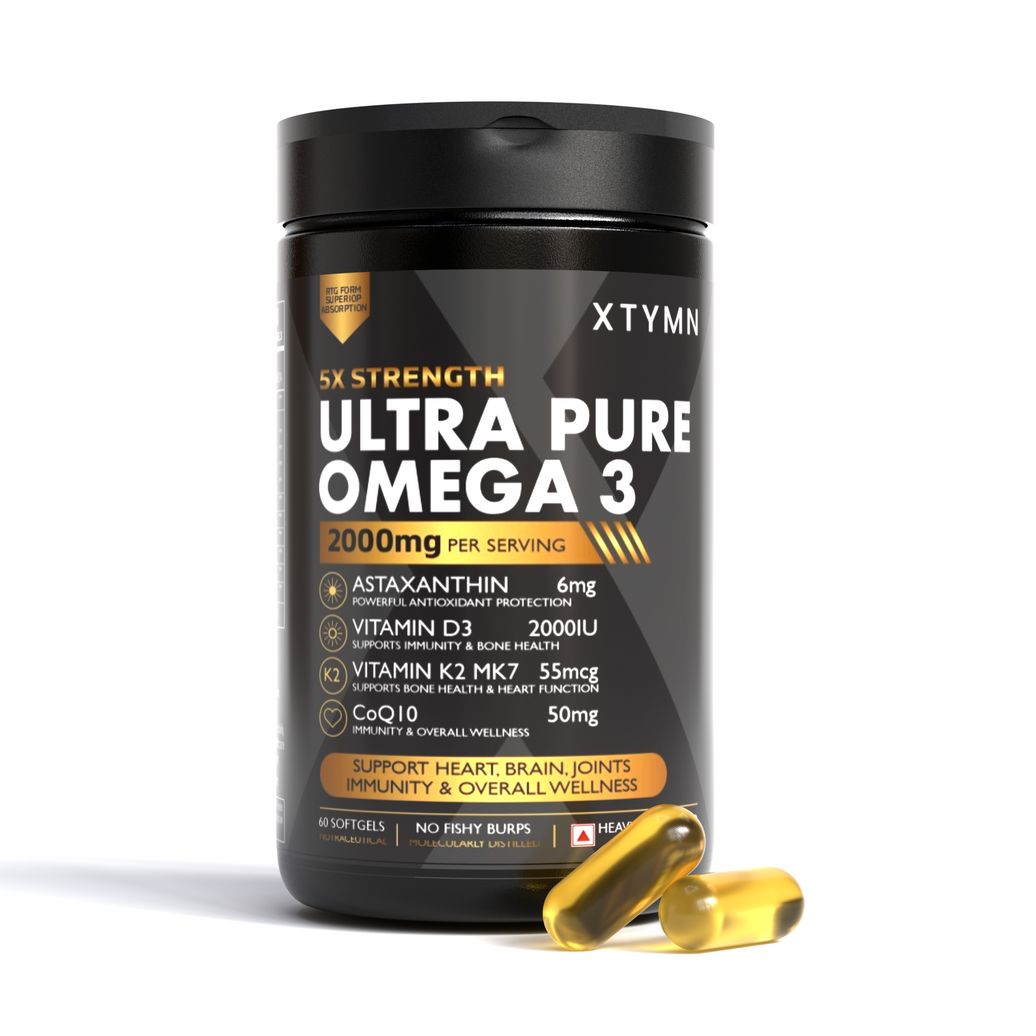






- Vitamin D3 raises how much calcium your gut absorbs from food. It does not decide where that calcium goes next.
- Vitamin K2 activates the two proteins that route calcium: osteocalcin, which binds it into bone, and matrix Gla protein, which keeps it out of artery walls.
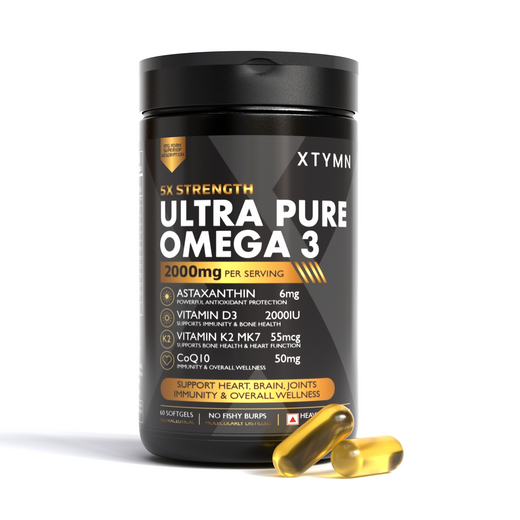
- 40 IU of D3 equals 1 mcg. Labels use both units, and both are correct.
- MK-7 is the K2 form that stays in circulation longest, which is what lets one capsule a day hold a steady level.
- Both are fat-soluble. Taken with the largest meal of the day, absorption is more predictable.
- If you take warfarin or another vitamin K antagonist, speak to your doctor before adding K2.
Vitamin D3 and vitamin K2 are usually sold as two separate bottles, and that separation hides how they work. D3 governs how much calcium crosses from your food into your blood. K2 governs what happens to that calcium after it arrives. Raise the first without the second and you have increased the supply of a mineral without giving it an address.
This is not a marketing pairing. It is a sequence, and every part of it can be checked against a label. What follows is the form, the dose, the evidence as it currently stands, and the parts that are still open.
What D3 actually does
Cholecalciferol, or vitamin D3, is not really a vitamin. Your skin makes it from a cholesterol precursor when UVB light reaches it. Your liver converts that to 25-hydroxyvitamin D, the form a blood test measures. Your kidneys then convert a small fraction into calcitriol, the active hormone. Calcitriol instructs the cells lining your intestine to build calcium transport proteins.
The size of that instruction is measurable. Without adequate calcitriol, adults absorb roughly 10 to 15 per cent of dietary calcium. With adequate levels, absorption rises to around 30 to 40 per cent.2, 3 That is the core mechanism. D3 also has documented roles in muscle function and immune signalling, but the calcium pathway is the one with the clearest dose-response data behind it.
Low vitamin D is common in India despite the sunlight. Indoor work, sunscreen, particulate pollution that scatters UVB, clothing coverage and higher melanin all reduce skin synthesis. Indian surveys report low 25-hydroxyvitamin D in a large majority of the urban adults measured.7 The signs are unhelpfully vague: tiredness, low mood, aching muscles, slow recovery after training, frequent minor illness. A blood test is the only way to know your own baseline, and it is worth having one before you decide on a dose.

What K2 actually does
Vitamin K carries out one chemical job: carboxylation. It adds a carboxyl group to certain proteins, which switches them on. Two of those proteins matter for this discussion.
Osteocalcin is produced by bone-building cells. Uncarboxylated, it cannot hold calcium. Carboxylated by vitamin K, it binds calcium into the bone matrix. Matrix Gla protein does the mirror job in soft tissue: once carboxylated, it inhibits calcium crystals from forming in artery walls and heart valves. Left uncarboxylated, it is inert.4, 6
So K2 is not a second absorption instruction. It is the routing layer. This is why a D3 formulation that ships with K2 is describing a complete step rather than half of one, and why the two are worth reading as a single line on a label.
The arithmetic on the label
Two unit systems are in use, which is where most label confusion starts. 40 IU of vitamin D3 equals 1 mcg. So 1000 IU is 25 mcg, 2000 IU is 50 mcg, and the 60,000 IU weekly sachet many Indian doctors prescribe is 1500 mcg. Neither unit is more honest than the other; you simply have to convert before you compare two products.
Vitamin K2 is dosed in micrograms, and the numbers are small enough that rounding changes the meaning. The long-term human trials that reported bone and arterial outcomes used 180 mcg of MK-7 daily, with shorter studies run at 90 mcg.5, 6 A capsule declaring 45 mcg of K2 is not mislabelled, but it sits well below the amount those trials tested, and that gap belongs in your comparison.
The form path
Vitamin D reaches shelves as D2 (ergocalciferol, from fungi) or D3 (cholecalciferol, from lanolin or from lichen for vegan formulations). Both raise blood levels. D3 raises them more efficiently per microgram and holds them longer, which is why it is the default in a serious formulation.
Vitamin K has a longer ladder. K1, phylloquinone, comes from leafy greens and is used mainly by the liver for clotting factors. K2 is a family of menaquinones named by side-chain length. MK-4 clears from blood within one to two hours, so it needs multiple daily doses to maintain a level. MK-7, fermented from natto, remains in circulation for roughly three days, which is what allows one capsule a day to keep carboxylation running instead of spiking and falling.4
If a label states only vitamin K2 with no menaquinone code, the form is undisclosed. That is a reason to ask the brand, not a reason to assume the answer.
Evidence: bone
The strongest long-term data on MK-7 comes from a three-year randomised controlled trial. It is worth reading for what it measured as much as for what it found.
What exists. A three-year randomised, placebo-controlled trial in 244 healthy postmenopausal women gave 180 mcg of MK-7 daily. Loss of bone mineral density at the lumbar spine and femoral neck was smaller in the supplemented group than in placebo, and vertebral height loss was reduced.5
What it does not show. Fractures were not an endpoint, so the trial cannot tell you about fracture risk. The cohort was postmenopausal women, so the result does not transfer directly to men or to younger adults. Vitamin D3 was not the variable under test.
Evidence: arterial calcium
The same cohort produced a second published outcome, and that shared origin is part of the honest reading of it.
What exists. In the same three-year cohort, 180 mcg of MK-7 daily was associated with lower arterial stiffness measured by pulse wave velocity, with the clearest difference in the women whose stiffness was highest at the start.6
What it does not show. Arterial stiffness is a surrogate marker, not an event. The trial did not count heart attacks or strokes, and it does not establish that K2 clears calcium already deposited in a vessel wall.

How much, and when
For a healthy adult with no diagnosed deficiency, the ICMR-NIN reference intake for vitamin D sits at 600 IU per day, and most maintenance formulations land between 1000 and 2000 IU.1 Higher therapeutic doses, including the weekly 60,000 IU regimen, are a clinical decision that follows a blood test, not a shelf decision.
For K2 as MK-7, 90 to 180 mcg daily covers the range the published trials used. Because MK-7 stays in circulation for about three days, timing within the day matters less than not skipping days.
Both vitamins are fat-soluble, so take them with the largest meal you eat, whichever meal that is. A capsule taken with black coffee on an empty stomach is absorbed less predictably. Consistency across weeks does more for your 25-hydroxyvitamin D level than any single well-timed dose, because the compound you are building is a blood level, not a sensation.
Expect nothing you can feel in the first fortnight. Serum 25-hydroxyvitamin D moves over six to twelve weeks. If you want to see the result rather than infer it, test before you start and test again after three months.
Who should be careful
If you take warfarin or another vitamin K antagonist, vitamin K2 interacts directly with the mechanism of your medication. Do not add it without your doctor adjusting and monitoring your treatment.
If you have chronic kidney disease, hyperparathyroidism, sarcoidosis, a history of calcium-containing kidney stones, or you are already prescribed calcium or vitamin D by a clinician, keep the decision with that clinician. Vitamin D is fat-soluble and accumulates, and stacking a prescribed weekly sachet on top of a daily supplement is the common way people overshoot without noticing.
If you are pregnant or breastfeeding, ask your doctor for a dose rather than choosing one.
How to read a D3 + K2 label
- Find the D3 amount and convert it. If the label shows micrograms, multiply by 40 to get IU; if it shows IU, divide by 40.
- Check the source of the D3. Lanolin and lichen are both disclosed sources; a blank is not a source.
- Find the menaquinone code on the K2 line. MK-7 should be stated. Vitamin K2 alone leaves the form open.
- Read the K2 amount in micrograms and place it against the 90 to 180 mcg range the trials used.
- Check whether the K2 is trans MK-7. The cis isomer is not biologically active in the same way, and brands that test for it usually say so.
- Look for a batch number and a certificate of analysis you can actually request. A claim without a document is a sentence, not a fact.
Questions we get
Can I just get vitamin D from sunlight?
Some of it, yes. Skin synthesis is real and efficient. It is also reduced by glass, sunscreen, air pollution, clothing, latitude, time of day and skin melanin. For an indoor worker in an Indian metro, sunlight alone is an unreliable input, and a blood test will tell you whether it is enough in your case.
Do I need K2 if I already take calcium?
K2 is the reason to ask the question at all, because it acts on where calcium settles rather than how much of it you take in. That said, this is a mechanism argument supported by surrogate-marker trials, not an outcome trial in calcium users. Discuss it with your doctor if you are on prescribed calcium.
Is more vitamin D better?
No. It is fat-soluble, it accumulates, and very high sustained intakes can raise blood calcium. The aim is an adequate blood level, which is a target to hit rather than a number to exceed.
Can vegans take D3?
Yes. Most D3 is derived from lanolin, which is sheep wool grease, but lichen-derived D3 is available and is chemically the same molecule. The label should say which one it used.
Why are they sold in the same capsule?
Because they describe one sequence. D3 increases the calcium available, K2 directs it. Both are fat-soluble, so they suit the same dosing moment with food. Combining them removes a step where people take one and forget the other.
The bone and arterial findings for MK-7 rest heavily on one three-year cohort of postmenopausal women. There is no equivalent long-term trial in men, in younger adults, or in Indian populations. No trial has yet shown that adding K2 to D3 reduces fractures or cardiovascular events, which is the endpoint that would settle the question. The optimal serum 25-hydroxyvitamin D target is still debated, and the dose needed to reach any given target varies with body weight, baseline and genetics. We will update this page when better data exists, and we will say so when we do.
- ICMR-NIN Expert Group. Nutrient Requirements for Indians: Recommended Dietary Allowances and Estimated Average Requirements. Hyderabad: National Institute of Nutrition, 2020.
- Institute of Medicine. Dietary Reference Intakes for Calcium and Vitamin D. Washington DC: National Academies Press, 2011.
- Holick MF. Vitamin D deficiency. New England Journal of Medicine. 2007;357(3):266-281.
- Schurgers LJ, Teunissen KJF, Hamulyak K, et al. Vitamin K-containing dietary supplements: comparison of synthetic vitamin K1 and natto-derived menaquinone-7. Blood. 2007;109(8):3279-3283.
- Knapen MHJ, Drummen NE, Smit E, Vermeer C, Theuwissen E. Three-year low-dose menaquinone-7 supplementation helps decrease bone loss in healthy postmenopausal women. Osteoporosis International. 2013;24(9):2499-2507.
- Knapen MHJ, Braam LAJLM, Drummen NE, et al. Menaquinone-7 supplementation improves arterial stiffness in healthy postmenopausal women. Thrombosis and Haemostasis. 2015;113(5):1135-1144.
- Ritu G, Gupta A. Vitamin D deficiency in India: prevalence, causalities and interventions. Nutrients. 2014;6(2):729-775.